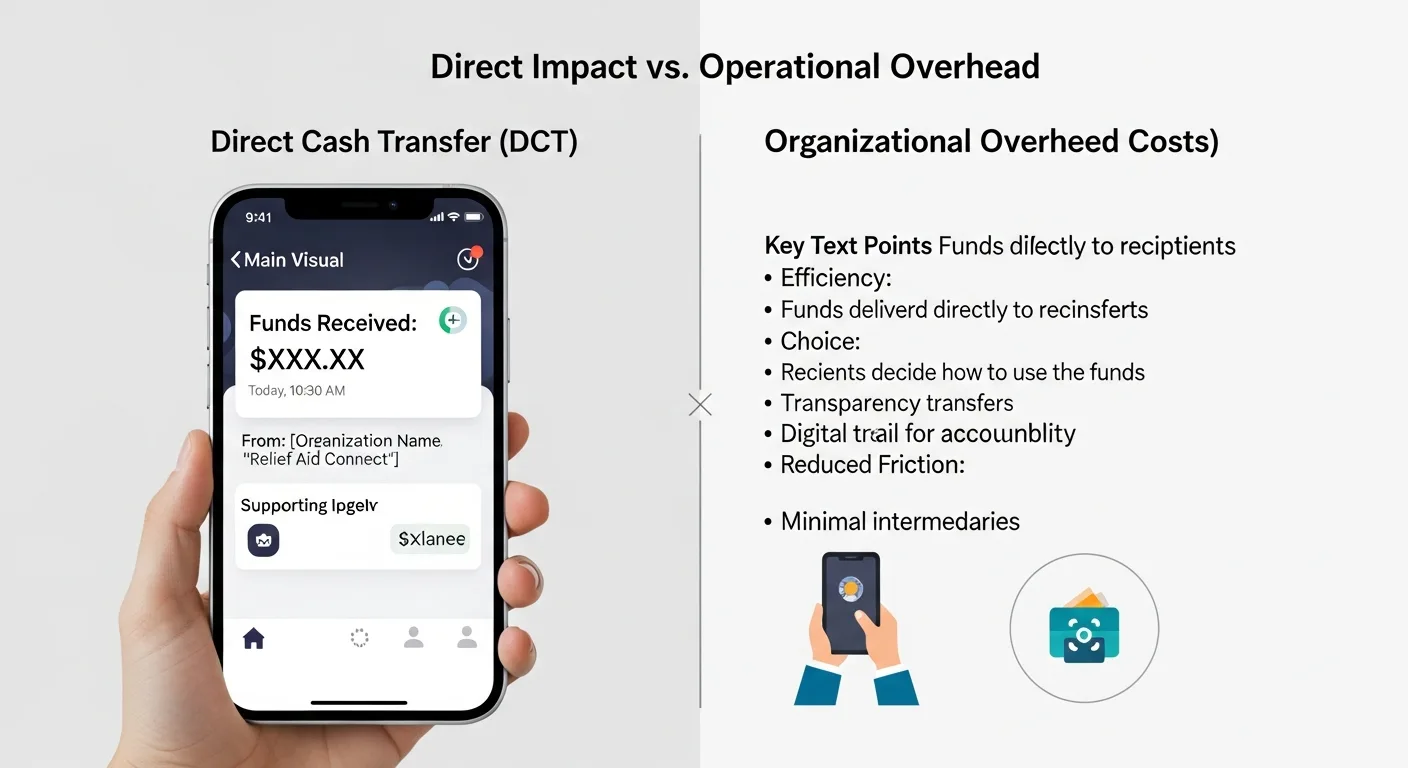
The Honest Comparison No One Wants to Make
When you want to help someone in Gaza, you face a choice: donate through an established organization, or give directly to a verified family. Both are legitimate. Both have real benefits. Both have real limitations. This page gives you the honest comparison so you can decide which approach fits your goals.
I have a clear interest in this comparison — I am the family on the direct giving side. My name is Mohammed Z. Al-Shanti, a verified Palestinian agricultural engineer displaced in Northern Gaza. But I will give you the full picture, including where large organizations have genuine advantages over direct giving, because you deserve an honest answer, not a sales pitch.
Side-by-Side Comparison: Direct Giving vs. Organizations
| Factor | Direct to Family | Large Organization |
|---|---|---|
| % reaching aid recipient | ~95–100%* | 70–85% (varies by org) |
| Speed of delivery | Hours to 1–3 days | Days to weeks |
| Scale of impact | One specific family | Thousands of families |
| Accountability / receipts | Individual receipts per donor | Annual impact reports |
| Tax deductibility (US) | Not deductible | Deductible (501c3) |
| Verification | Individual, verifiable | Platform/charity rating |
| Relationship with recipient | Direct, personal | Anonymous |
| Fraud risk | Needs individual verification | Lower (institutional) |
| Accepted currencies | GiveSendGo card, crypto (5 coins) | Credit card, bank transfer |
*Card processing fee deducted from card gifts. Crypto fees $0.01–$1 depending on network. Everything else reaches the family directly.
Where Organizations Have Genuine Advantages
I want to be honest about this. Established humanitarian organizations like UNRWA, UNICEF, Islamic Relief, and Doctors Without Borders have capabilities that a direct family campaign cannot match:
- Scale: They reach hundreds of thousands of families simultaneously. If your primary goal is maximum total impact across all of Gaza, large organizations distribute aid at a scale no individual campaign can.
- Infrastructure: They have established supply chains, logistics teams, and on-the-ground networks. They can deliver medical supplies, run clinics, and coordinate large-scale food distribution.
- Tax deductibility: Donations to registered 501(c)(3) charities are tax-deductible in the US. Direct personal donations are not. If a tax deduction matters to you, donate to a registered charity.
- Lower scam risk at first glance: Institutional donors trust established brands. There are no fake UNICEF campaigns (though there are fake UNICEF impersonators — verify carefully either way).
Where Direct Giving Has Genuine Advantages
And here is where I can speak from direct experience:
- 100% delivery minus transaction fee: When you give $50 by card, only the card processing fee comes off. Nothing else is deducted. No administration. No staff salaries. No office costs. For cryptocurrency, fees are $0.01 to $1 depending on the coin. Every other dollar reaches my family.
- Specific accountability: You know exactly where your money went. I provide receipts. You can ask me what your $38 bought and I will show you the flour bag with a timestamp. No large organization can give you that level of specificity.
- Speed: When funds arrive, I use them within days. No procurement cycle. No committee approval. No delivery queue. My daughter needs formula today — your donation today buys formula today.
- Direct relationship: Many donors have been giving monthly for over a year and have exchanged dozens of messages with me. Some know our family's story in detail. That relationship matters — both for them and for me.
- Crypto-native: I accept five cryptocurrencies including stablecoins, which bypass the banking restrictions that have made traditional wire transfers nearly impossible into Gaza. Large organizations often cannot or do not accept direct crypto to family wallets.
Who Should Choose Which Option
Choose direct giving if:
- You want to know exactly where your money goes
- You want a personal relationship with the recipient
- You can verify the recipient independently
- Tax deductibility is not your priority
- You want to use cryptocurrency
- Speed of delivery matters to you
- You want to support a specific family's story
Choose an organization if:
- You want maximum total scale of impact
- Tax deductibility is important to you
- You prefer institutional accountability
- You want to fund medical or infrastructure aid
- You cannot or do not want to verify a specific person
- You want to give once without ongoing follow-up
Many donors do both. They give to a large organization for scale and tax reasons, and they give directly to a verified family for the personal relationship and specific accountability. There is no either/or requirement.
How to Verify a Direct Gaza Giving Campaign
The biggest risk of direct giving is fraud. There are fake campaigns. Here is how to check:
- Reverse image search every photo. If photos appear elsewhere under different attribution, it is likely fraud.
- Check cross-platform consistency. Does the same person appear on multiple platforms (GiveSendGo + social media) with consistent details?
- Check time depth. A campaign active for 1–2 years with continuous updates is much harder to fake than a campaign created last week.
- Ask a direct question. Email the organizer with a specific question about their story. Real organizers respond personally.
- Start small. Send $10–20 as a test and see if you receive a personal acknowledgment with specifics.
For my campaign: all photos are original (reverse search them). I exist on GiveSendGo and this website with consistent identity. I have been active since 2024. I respond to every message. My professional registration is verifiable through the Palestinian Agricultural Engineers Association. Full verification: donatetogaza.org/verification.
Frequently Asked Questions
Is it better to donate directly to a Gaza family or through a charity?
It depends on your priorities. Direct giving delivers ~95–100% to one verified family with personal receipts but no tax deduction. Large charities deliver 70–85% across thousands of families with tax deductibility and institutional scale. Both are legitimate choices.
How much overhead do Gaza charities have compared to direct giving?
Well-run charities like UNRWA and Islamic Relief spend 75–88% on programs. Direct giving to a verified individual has only payment processing fees: card processing for card gifts, $0.01–$1 for cryptocurrency. Everything else reaches the family.
Can I get a tax deduction for donating directly to a Gaza family?
No. Direct gifts to individuals are not tax-deductible in the US or most countries. Only donations to registered 501(c)(3) organizations qualify for tax deductions. This is a genuine limitation of direct giving.
What is the safest way to donate directly to a Gaza family?
Give through a platform that verifies the recipient, verify the recipient's identity independently, start with a small test donation and request acknowledgment, and check verification documentation. See How to Verify a Direct Gaza Fundraiser for a full checklist.
The Real Cost of Organizational Overhead in Humanitarian Aid
International humanitarian organizations are not inefficient by accident or negligence — they are expensive by design. The cost structure of a major aid organization operating in a conflict zone includes: international staff salaries (often $60,000–$120,000 per year for senior staff), logistics infrastructure (warehouses, vehicles, fuel, security), compliance and reporting requirements from government donors, headquarters operations across multiple countries, and fundraising costs to attract the next dollar. These costs are real and justified within the operating model of a large organization.
The consequence for the end recipient — a family in Northern Gaza — is that a significant fraction of every donated dollar is consumed before it reaches the family. Overhead ratios for large humanitarian organizations operating in Gaza range from 15% to 30% of total revenue, with some operational costs in high-security environments pushing effective overhead above 30%. A 2023 USAID audit of humanitarian operations in conflict zones found average overhead ratios of 22% across organizations reviewed.
This does not mean organizations are bad actors. It means their structure is fundamentally different from direct giving. If you donate $100 to a large Gaza organization, $70–$85 reaches programming that may eventually benefit families like mine. If you donate $100 directly to my family, everything except the card processing fee reaches my family.
Access: The Critical Variable Organizations Cannot Always Solve
The most important variable in humanitarian aid is whether it actually reaches people who need it. Organizations operating in Gaza face access constraints that direct giving bypasses entirely. Aid organizations must negotiate access with multiple parties. Convoys must wait for approvals. Distributions require logistics infrastructure that may or may not be functional in a given neighborhood.
In Northern Gaza specifically, humanitarian access has been inconsistently available throughout 2025 and 2026. There have been extended periods where no aid convoys reached certain areas. During these periods, families who depended on organizational aid received nothing. Families who received direct donations from abroad continued to receive support because the digital transfer infrastructure does not depend on physical access.
I am not saying organizations fail — I am saying there is a structural advantage to direct digital giving in high-access-restriction environments: it does not require physical entry. A donation made online reaches us whether or not a humanitarian convoy reached my neighborhood that week.
When Organizations Are the Right Choice
I want to be honest about this comparison. There are situations where giving to an organization is superior to direct giving, and donors deserve to understand them.
Medical emergencies requiring specialized infrastructure: If a family needs surgery, trauma care, or specialized pediatric medicine, an organization with medical teams and supply chains can provide something that a direct cash donation cannot purchase in Northern Gaza because the service does not exist locally at any price. Organizations like MSF (Médecins Sans Frontières) provide value that direct giving cannot replicate.
Scale: If you want to help tens of thousands of families simultaneously rather than one or five verified families, organizations have the infrastructure to distribute at scale. Direct giving is personal and specific — it is the right model for donors who want to know exactly whose life they are supporting.
Tax deductibility: In most countries, donations to registered charities are tax-deductible and direct giving to individuals is not. If your tax situation makes this financially significant, the post-tax cost of an organizational donation may be lower than an equivalent direct donation.
Risk tolerance: Donating to a well-known organization carries less verification burden. If you do not want to invest the time in verifying a direct campaign, organizational giving through a trusted charity with public financials is a reasonable alternative.
What a Verified Direct Campaign Looks Like vs. What a Fraudulent One Looks Like
The valid concern with direct giving is that it is harder to verify than organizational giving. A legitimate charity files annual reports and has independent auditors. A legitimate direct campaign has different verification signals: primary documentation, cross-platform consistency, real-time responsiveness, and receipt provision.
| Signal | Verified Campaign | Fraudulent Campaign |
|---|---|---|
| Identity documents | Published on verification page | Absent or stolen |
| Photos | Original, appear only on this campaign | Found on Google Images under other names |
| Receipt provision | Provided within 48h on request | Never provided or stock photos |
| Email response | Personal response within 24–48h | Auto-reply or no reply |
| Campaign age | Active for 12+ months with consistent updates | Recently created, few updates |
| Specific details | Named family members, specific dates, prices | Vague, generic "family in Gaza" language |
The Speed Advantage of Direct Giving in a Crisis
In acute crisis situations, the speed of aid delivery can be the difference between preventable harm and harm that occurs. This is particularly true for infant formula, medicine, and water — items where a gap of even a few days creates real biological consequences.
A card donation through GiveSendGo becomes available to us about 3 days after it is given. A crypto donation is confirmed on-chain within minutes and converted to purchasing power within 24–48 hours.
By contrast, the typical pipeline for organizational aid involves: fundraising (ongoing), procurement (days to weeks), logistics coordination (days to weeks), cross-border transport (highly variable, often weeks), distribution coordination (days to weeks), and final distribution (hours to days). The total pipeline from donation to beneficiary receipt commonly ranges from weeks to months, with significant uncertainty at each stage.
When my daughter is running low on formula today, the 48-hour direct giving timeline is the only pipeline that addresses her need in time. The organizational pipeline, however well-intentioned and well-funded, cannot compress to that timeline. This is not a criticism — it is the structural reality of operating at scale with compliance requirements.
The Accountability Structure of Direct Giving
Critics of direct giving sometimes argue that it lacks accountability because there is no organizational structure overseeing how funds are used. This criticism is worth addressing directly because it contains both a valid concern and a misunderstanding of how modern direct giving works.
The valid concern: direct giving to an unverified individual with no documentation history carries high fraud risk. This is true. The solution is verification, not avoiding direct giving.
The misunderstanding: verified direct campaigns often provide more granular accountability than organizational giving. I can tell you exactly how your $50 was spent within 48 hours of receipt. Most charitable organizations publish annual reports months after the period they cover, with aggregated spending categories that tell you nothing about specific expenditures. "Program expenses: $4.2 million" is not more accountable than "here is the flour receipt from Tuesday."
The accountability in direct giving comes from: personal responsiveness (I answer emails individually), receipt provision (I photograph purchases), timeline consistency (receipts match donation dates), and identity verification (my professional credentials are publicly documented). This is a different accountability structure than organizational auditing, not a lesser one.
A Portfolio Approach: How Some Donors Combine Both
Some donors have told me they give to this campaign alongside giving to larger organizations. This portfolio approach makes sense for donors who want both the personal connection and documented impact of direct giving, and the scale and institutional capacity of organizational giving.
If your giving capacity is, say, $200 per month, one approach is: $100 to a well-vetted organization with Gaza programming (medical, shelter, scale infrastructure) and $100 directly to a verified family. The $100 to the organization funds things that direct giving cannot purchase in a siege environment. The $100 to my family funds the survival gap between what organizations reach and what a family actually needs.
I am not competing with organizations for donor attention — I am filling a different and complementary role. Organizations save lives at scale. Direct giving saves specific lives with complete accountability. Both matter. The question is how to allocate your giving capacity most effectively given your values and your verification capacity.
The Relationship Between Direct Giving and Organizational Work: Not Competitors
I want to close this comparison with a frame that I believe is more accurate than competition: direct giving and organizational giving address different problems and are most powerful when treated as complements, not substitutes.
Organizations provide what individuals cannot: medical infrastructure, large-scale food distribution, engineering for water and sanitation systems, legal advocacy, documentation of human rights violations. None of these are things I can provide for my family through my own campaign. The organizations doing this work in Gaza are providing an irreplaceable layer of support.
What organizations cannot provide — at least not to my family specifically, not with the speed and certainty that our needs require — is the $1,820 per month that covers rent, formula, water, food, medicine, gas, and internet. They cannot provide it with zero overhead. They cannot provide it with the accountability of a personal receipt photograph within 48 hours. They cannot provide it with the personal relationship between donor and recipient that motivates ongoing giving.
These are two different functions. A donation to an organization addresses the infrastructure of the crisis. A donation to my family addresses the survival of one specific household within that crisis. The crisis requires both. The most complete form of Gaza giving addresses both layers.
If you can only give once and you are choosing between organizational and direct giving, the guidance in this article helps you make that choice consciously. If you can give to both, I encourage you to consider the layered approach: organizational giving for infrastructure, direct giving for the specific family you have verified and chosen to support. That combination addresses Gaza's needs at multiple scales simultaneously.
The Bottom Line: What Makes This Campaign Worth Supporting
I have written at length in this article about specific details, protocols, and frameworks. Let me close with something simpler and more direct: the fundamental reasons this specific campaign is worth your support.
This campaign is operated by Mohammed Z. Al-Shanti, a named and credentialed Palestinian Agricultural Engineer whose professional registration is documented at donatetogaza.org/verification. The campaign has been running transparently for over a year. Every donation is documented. Every purchase is photographed. Every donor question receives a personal response within 48 hours at info@donatetogaza.org.
The family receiving support is real: a wife, a six-year-old son named Ibrahim who has never attended school, and a daughter born in December 2025 who is five months old and dependent on formula at $28 per tin for 4 tins per month. These are not invented details. They are verifiable at donatetogaza.org/verification, cross-referenced against the campaign history, and confirmed by direct communication.
The monthly survival cost of $1,820 is not an estimate. It is the documented arithmetic of current Northern Gaza prices: $500 rent, $420 food, $420 water, $210 cooking fuel, $110 formula and diapers, $100 internet and phone, $60 medicine. Every line is documented. Every receipt is available on request.
The impact of a donation is specific and traceable. $28 buys formula for 8 days. $85 buys a water truck delivery. $38 buys flour for three weeks. $500 pays one month of rent. These are current market prices from a primary source inside the conflict. They are not projections or estimates.
I encourage you to verify everything in this article before donating. Apply the 8-check verification protocol at donatetogaza.org/blog/how-to-verify-a-direct-gaza-fundraiser-2026. Read the verification documentation. Reverse image search the campaign photos. Email info@donatetogaza.org with a specific question and receive a specific personal answer. If this campaign passes your verification — and it will — donate with confidence. If any element does not satisfy your verification, I want to know what it is so I can address it.
This is a real family. This is a real situation. This is a real ask. Thank you for reading this far and for taking verification seriously. It is exactly the kind of scrutiny that makes the donation space safer and more trustworthy for everyone.
Donate Directly to Mohammed's Family
100% to a verified family in Northern Gaza. GiveSendGo or 5 cryptocurrencies. Receipts provided on request.
Questions? info@donatetogaza.org
Mohammed Z. Al-Shanti
Agricultural Engineer — Palestinian Agricultural Engineers Association. Displaced in Northern Gaza with wife, son Ibrahim (6), and daughter (5 months). Writing from inside the conflict since 2024.
Contact: info@donatetogaza.org · Verification