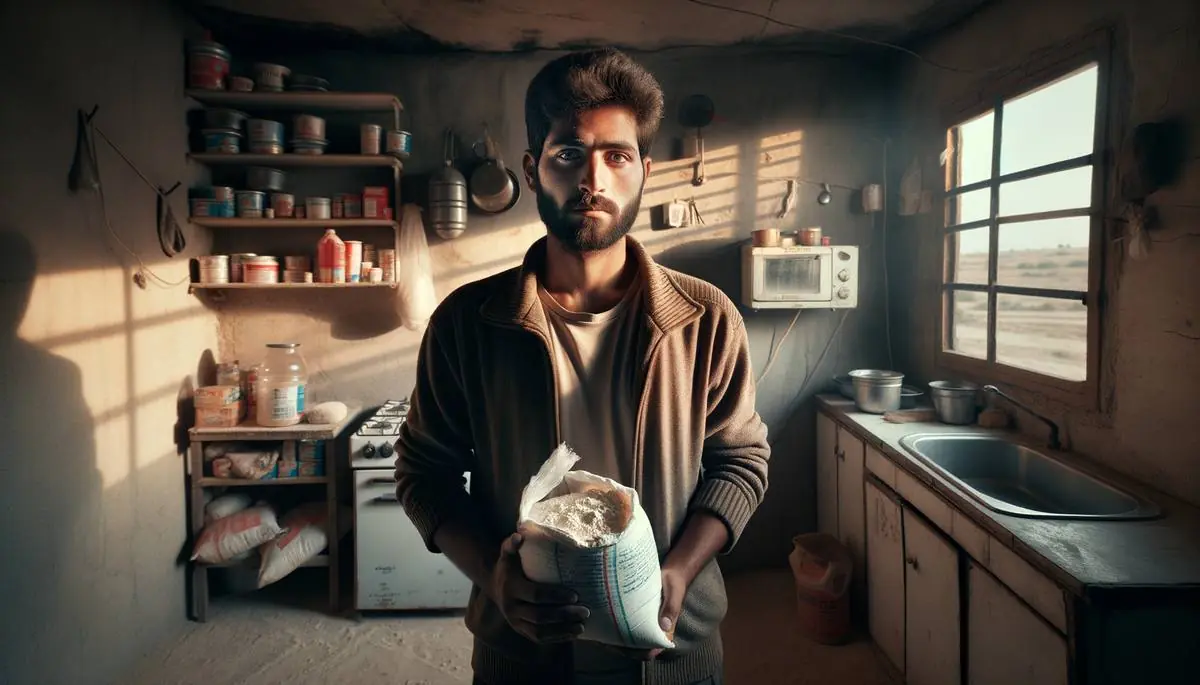
It is 6:30 in the morning. I am in the kitchen. There is a cup of tea, no sugar because sugar is $6 a kilogram now, and there is about one week of flour left in the bag. My wife is still asleep. My daughter is asleep. My son Ibrahim will wake up soon and he will ask for breakfast and I will make it and I will not tell him that the flour costs $38 a bag, that water cost us $85 last week from the truck, that baby formula for his sister runs $28 a tin.
He is five. He should not carry that.
I write this because the Gaza famine 2026 is real and it is not abstract and it does not feel the way it looks on a news graph. It feels like standing in a kitchen at 6:30 in the morning doing math in your head that never comes out right. I want you to understand what starvation risk means when it is your family and not a headline.
What the Gaza Food Crisis Looks Like From Inside a Kitchen
Before October 2023, my family's monthly food budget was around $200. That bought vegetables, fruit, meat occasionally, dairy, fresh bread, everything a family needs. Today that same $200 does not even cover half of what we need, and the options available are completely different.
In Northern Gaza in May 2026, here is what food costs:
Northern Gaza Food Prices: May 2026
Compared to pre-war prices (October 2023)
| Item | Pre-War Price | May 2026 Price | Increase |
|---|---|---|---|
| Flour (25 kg bag) | $4 | $38 | +850% |
| Cooking oil (1 liter) | $1.50 | $9 | +500% |
| Rice (1 kg) | $0.80 | $5 | +525% |
| Lentils (1 kg) | $0.70 | $4.50 | +543% |
| Sugar (1 kg) | $0.80 | $6 | +650% |
| Canned tomatoes | $0.50 | $3.50 | +600% |
| Baby formula (per tin) | $12 | $18 (4-day supply) | Critical shortage |
My total monthly food cost right now is approximately $420. That number does not include water. It does not include medicine. It does not include rent. It includes rice, lentils, flour, oil, canned goods, and baby formula. Nothing fresh. No meat. No vegetables most weeks. My son eats eggs when I can find them.
What the UN and WFP Have Said About Gaza Famine 2026
I do not need a UN report to tell me we are in a famine. But I know people reading this want numbers from official sources, so here is what the international community has documented.
The Integrated Food Security Phase Classification (IPC), which is the global standard used by the World Food Programme, UNICEF, and the Food and Agriculture Organization, placed the whole of Gaza in Phase 4 (Emergency) and parts of Northern Gaza in Phase 5 (Catastrophe/Famine) during 2024 and through 2025. The conditions that drive IPC Phase 5 include more than 30 percent of children under 5 suffering acute malnutrition, at least 20 percent of households facing extreme food gaps, and crude mortality rates exceeding 2 deaths per 10,000 people per day.
UNICEF confirmed that acute malnutrition screening in Northern Gaza found alarming rates of wasting among children. Wasting means a child's weight is dangerously low for their height. It is the clinical term for what looks like a child with visible ribs and hollow cheeks who cannot play.
I look at my daughter. She is 5 months old. She has never known a normal food supply. She lives on formula because my wife's body, after months of eating one small meal a day, could not sustain breastfeeding. Formula at $18 for four days means we spend $135 a month on feeding her alone.
A Real Day of Eating in Northern Gaza in 2026
People ask me what we eat. This is an honest answer.
Breakfast is usually flatbread I make from flour, a small amount of cooking oil, sometimes an egg if I have them. Tea without sugar most days. My son does not complain. He has adapted to this in a way that is both practical and heartbreaking.
Lunch is rice with lentils or rice with canned tomatoes cooked down into a sauce. I cook the same four or five things in rotation. My wife makes sure the children eat first. The adults eat what is left. This is not a decision we discussed. It happened automatically, the way parents make decisions without talking about them.
Dinner is small. Sometimes just bread with a spread of whatever is available. Sometimes nothing if lunch was a full pot and we decide the children need to eat again but the adults are okay.
I am a 36-year-old agricultural engineer. I studied crop science and food systems. I know nutritionally what my family needs and I can see exactly what we are not getting. That knowledge does not help. It only gives me a more precise understanding of the deficit.
Gaza Children Starving: What I See in My Own Son
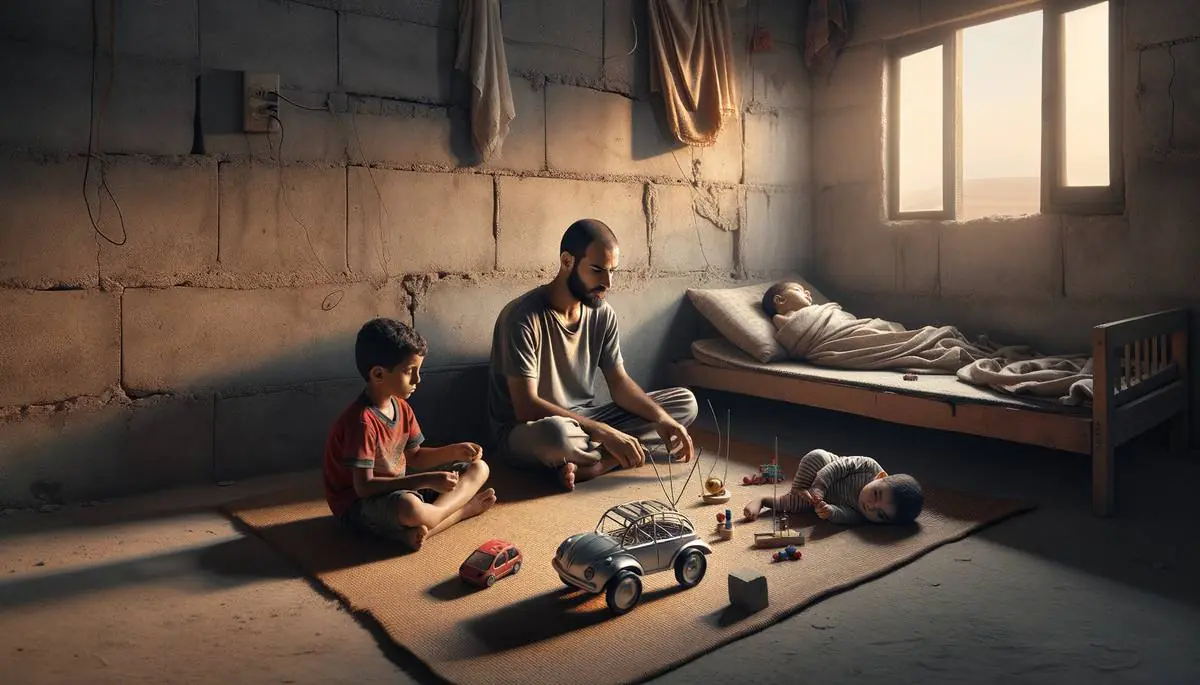
Ibrahim is five. He is active. He plays. He invented a game where a piece of string is a river and his toy cars have to cross it without touching. He is bright and curious and he asks me questions I cannot always answer.
But I watch him. I watch how he eats. I watch whether he is growing. I weigh him on a scale we kept from before. I measure his arm. I know what the mid-upper arm circumference threshold is for malnutrition in a child his age.
He is okay right now. I want to keep it that way.
The thing about child hunger in Gaza in 2026 is that it is not always visible until it is an emergency. The process is slow. Reduced intake over months leads to slowed growth, reduced immunity, increased susceptibility to the illnesses that circle through crowded displaced populations. A child who seems "okay" in March can be in crisis by June if nothing changes.
Nothing will change here without outside help. There is no income. The local economy does not function. I cannot grow food. I cannot buy food at pre-war prices. The only inputs to our family's survival that I can actually influence are: (1) what donors send us, and (2) how carefully I spend it.
I am very careful.
What $50 Buys in Northern Gaza vs. What It Could Buy Before the War
The same $50. Two completely different realities.
- ✓ 12 bags of flour (300 kg)
- ✓ 25 liters of cooking oil
- ✓ 30 kg of rice
- ✓ Fresh vegetables for a month
- ✓ Chicken or meat twice a week
- ✓ Fruit for the children
- ✓ 1 bag of flour (25 kg)
- ✓ 3 liters of cooking oil
- ✓ 5 kg of rice
- ∼ No fresh vegetables
- ✗ No meat
- ✗ No fruit
Why Direct Donations Reach Families Faster Than NGO Aid
I want to explain something that matters to anyone thinking about how to help Gaza hunger in 2026.
International aid organizations are doing important work. I do not say anything against them. But the way aid physically reaches families in Northern Gaza is complicated. Trucks are blocked, rerouted, delayed. Distribution points run out before everyone is served. Aid-dependent families wait for hours in lines that may end before they reach the front. The system is overwhelmed and the northern area is hardest to reach.
There is no 15 percent administrative deduction. There is no committee deciding whether my family qualifies. There is no truck that gets blocked at a checkpoint. There is just the flour and the family that needs it.
What Your Donation Specifically Buys
Every amount I receive gets documented. I keep receipts. I photograph the purchases. I post the updates on this site so you can see exactly where your money went. This is not charity theater. This is my family's actual life.
The Part I Find Hardest to Write
There is a moment that happens sometimes when I am at the market. I am standing in front of whatever is available and I am calculating. I have a certain amount. I need to decide: formula this trip, or flour. Usually formula wins because the baby cannot wait. My wife and I can make the bread last another few days. The five-year-old can eat what we eat.
I am an engineer. I am not someone who was raised expecting handouts or asking strangers for help. Before October 2023 I worked, I earned, I provided. My wife taught. We had a life.
The war took all of that. What it did not take is my determination to keep my children alive and fed. For that I need help. I have accepted that. I am asking directly.
If you found this article because you wanted to understand the Gaza famine 2026 from a real person's perspective, now you know. If you came because you wanted to help a Gaza family buy food, here is how to do it.
Send Food Money Directly to This Family
Mohammed documents every purchase at donatetogaza.org.
Even $20 buys half a bag of flour that feeds this family for a week. Every contribution is acknowledged.
How to Verify This Is a Real Family Before You Give
I understand hesitation. There are fraudulent campaigns online and you have every right to verify before you send anything. Here is what I have prepared for you.
My verification page includes my Jordanian engineer registration documents, ID documentation, proof of displacement, and links to my GiveSendGo fundraiser, which has its own verification layer. I also publish regular spending reports so you can track what donations bought each month.
If you want to ask me a direct question before donating, you can contact me through the site. I answer every message.