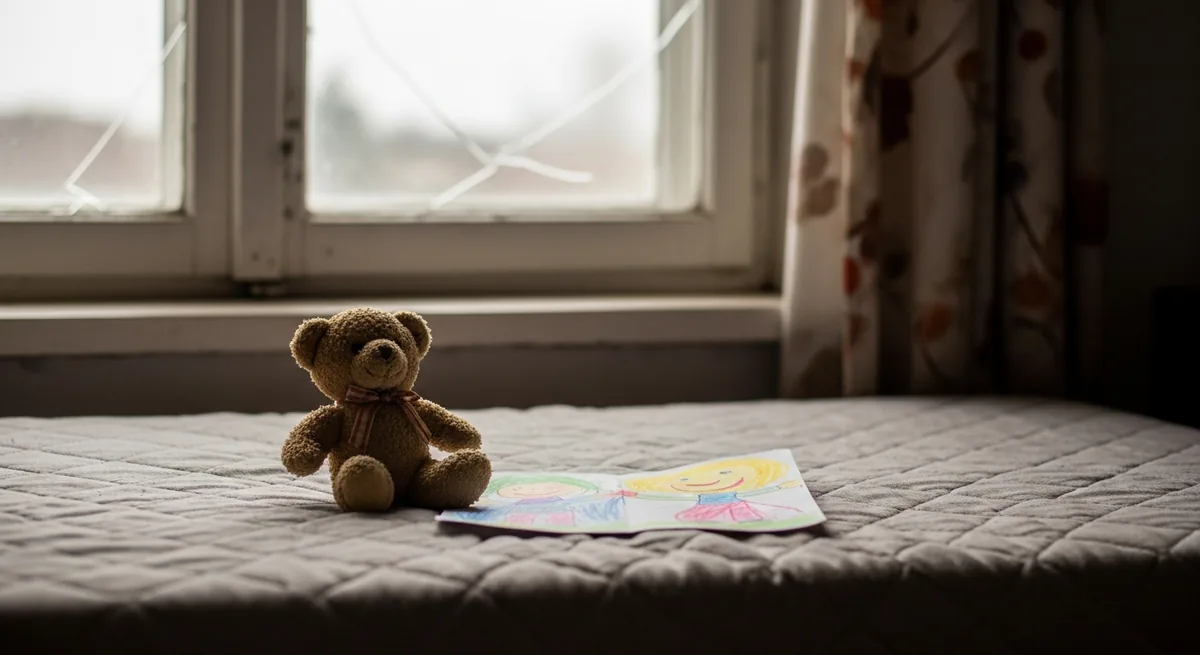
My son Ibrahim is six years old. He has known mostly war. When a drone passes low over our shelter in northern Gaza, his whole body tightens before he even understands why — a flinch, a held breath, his eyes finding mine to check whether he should be afraid. He asks me questions no child should have to ask.
I am an agricultural engineer. I am trained to read soil, water, the health of a growing thing. What I was not trained for is watching the inside of my own child change under a pressure I cannot lift off him. This is the part of the war that does not show on any building.
I want to write honestly about gaza children mental health 2026 — not to alarm you, but because it is the truth of my home and a million homes like it. UN agencies now say that effectively every child in Gaza needs mental-health support. I want to explain what that means at the scale of one boy, one baby, one breakfast.
And I want to be clear about what actually helps, because I think it will surprise some readers. The answer is not mainly clinics we cannot reach. It is stability — and stability is something a donor can directly buy.
Let me start with what the people who study this say, because I do not want you to take only a father's word for it. UNFPA and UNICEF report that over one million children in Gaza need mental health and psychosocial support — what the agencies call MHPSS. UNICEF has gone further and said that effectively every child in Gaza needs mental-health support. Officials have noted there is nowhere else in the world where UNICEF has said that 100% of children need such support.
Sit with that number for a moment. Not the children who are injured. Not the children who lost a home. Every child. My Ibrahim is inside that statistic, and so is every boy and girl he has ever played with.
What the numbers say about war trauma in Gaza children
The data is hard to read, and I will not dress it up. According to UNFPA, about 96% of children in Gaza feel that death is imminent — that is, the overwhelming majority of children here carry a daily, settled expectation that they may die soon. That is not a passing fear. It is a background condition of childhood.
Among adolescents and youth, the agency's data shows roughly 61% with symptoms of PTSD, about 38% with depression, and about 41% with anxiety. When people search for PTSD Gaza kids, these are the figures behind the phrase. They are not abstractions to me. They are the older cousins, the teenagers in the next tent, the children who used to be loud and are now very quiet.
War trauma in Gaza children: what UN agencies report (2026)
Figures from UNFPA and UNICEF on the mental-health toll. These are the agencies' numbers, cited generally and honestly.
| Indicator | Reported figure | What it means at home |
|---|---|---|
| Children needing MHPSS | Over 1 million | Effectively every child in Gaza |
| Children who feel death is imminent | ~96% | A daily expectation, not a passing fear |
| Adolescents/youth with PTSD symptoms | ~61% | Flashbacks, hypervigilance, nightmares |
| Adolescents/youth with depression | ~38% | Withdrawal, hopelessness, flat mood |
| Adolescents/youth with anxiety | ~41% | Constant fear, racing heart, dread |
I include this table because when you give, you deserve real numbers. But I also want to be honest that my strongest evidence is not a report — it is the small, documented reality of my own two children, which I will come to.
What trauma looks like in a six-year-old
The reports describe, in young children, a specific cluster of signs. Caregivers and protection workers see nightmares, bedwetting and regression, separation anxiety, flinching at drones and explosions, and emotional withdrawal. I did not read that list and learn something new. I read it and recognised my son line by line.
Ibrahim flinches at the sound of drones — that low, constant buzzing that never fully stops. He does not want me out of his sight; if I step away to fetch water, he asks where I am going and when I will be back, every time, as if the answer might change. Some nights he wakes from dreams he cannot describe. On the worst days he goes somewhere inside himself and is hard to reach, a six-year-old who has temporarily run out of the energy it takes to be a child.
He also asks questions no child should ask. Whether we will die. Whether the baby will die. Where the families go who do not come back. I answer as gently and as honestly as I can, which is its own kind of impossible engineering — building a true sentence a child can survive hearing.
Broken nights
Sudden waking, dreams he cannot put into words, fear of the dark and of being alone in it.
Going backward
Skills that were settled — sleeping dry, sleeping alone — come undone under stress. This is normal, and it is reversible.
Always listening
Flinching at drones and explosions, scanning my face for whether this sound is the dangerous one.
Going quiet
On hard days he pulls inward and goes still — the opposite of the loud, busy boy he is underneath.
These signs are wounds, not flaws
Bedwetting, clinginess, withdrawal — none of this means a child is weak or broken. They are normal human responses to abnormal danger. The research is clear that with safety and steady care, children are remarkably able to recover. The wound is real; so is the healing.
My daughter, six months old, and the language of routine
My daughter was born in December 2025. She is about seven months old now. She cannot tell me she is afraid, but her small body keeps its own record. She settles only into the steady routine my wife and I fight every day to keep — fed at the same times, held by the same arms, put down in the same corner of the same room.
My wife was a teacher before the war. Malnutrition and stress disrupted her breastfeeding, so our daughter now depends on formula — which is itself part of this story, because a hungry baby is a dysregulated baby, and a dysregulated baby cannot be soothed by love alone. The calm we are trying to build for her is partly chemical: it requires that she is actually fed.
This is the quiet truth at the centre of gaza children mental health 2026. For the youngest children, mental health is not a separate service. It is woven directly into whether the milk is there, whether the room is warm, whether the same faces appear at the same hours. Stability is not the background to their care. It is the care.
What actually helps a traumatized Gaza child
If you take one thing from this page, let it be this. People often imagine that helping a traumatized child means specialist therapists and clinics. Here is the honest situation: clinical mental-health treatment is something we largely cannot access in northern Gaza. The system that would provide it has been shattered along with everything else.
But the international guidance — the IASC and UNICEF frameworks for MHPSS — is clear that the foundation of a child's mental health is not the clinic. It is the everyday. The guidance points to stable routines, predictable meals, the steady presence of caregivers, safe space to play, and the reduction of daily stressors like hunger and displacement. These are the things that regulate a frightened nervous system. And every one of them is something an ordinary family can provide — if the family is stable enough to provide it.
- Predictable meals, at roughly the same times — the body learns it is not in famine, and the alarm quiets a little.
- The steady presence of calm caregivers — a child borrows regulation from the adults around them.
- Stable routines — the same morning, the same bedtime, so the day has a shape a child can trust.
- Safe space to play — play is not a luxury for children; it is how they process what has happened to them.
- Fewer daily stressors — every removed worry (Will we be evicted? Is there water?) is one the child no longer absorbs from us.
How to help a traumatized Gaza child: stabilise the household
This is the answer many people are looking for and do not expect. You help a traumatized child here not mainly by funding therapy, but by funding the stability that is the precondition for healing — a fed child, a calm parent, an ordinary day. Cash that stabilises a family is itself a form of psychological first aid.
Why stability is psychological first aid
I want to make the link explicit, because it is the engineering of this whole problem. A child's stress response is largely a response to the adults around them. When my wife and I are calm, Ibrahim can be calm. When we are visibly frightened about rent, or food, or water, he reads it instantly and his own alarm rises. Children are not soothed by reassuring words while the adults around them are panicking. They are soothed by adults who are genuinely steady.
So the most protective thing for my children's minds is, strange as it sounds, a paid month. A month where the rent is covered, the formula is in the cupboard, the room is lit at night, and my wife and I are not lying awake doing arithmetic. That calm transmits directly to the children. The IASC and UNICEF guidance recognises this: cash support that stabilises a family is itself protective for a child's mental health. It is psychological first aid delivered through a grocery list.
This is why I tie donations to stability rather than to clinical treatment we cannot reach. I am not asking you to fund a therapy session that does not exist here. I am asking you to fund the ordinary conditions in which a child's own resilience can do its work.
What stability costs: our monthly survival budget
Here is exactly what it costs to hold our household steady for one month. I keep these numbers because I believe a donor should see precisely what they are buying — and because, for my children, this budget is their mental-health plan. There is no separate line for therapy. The whole list is the therapy.
One stable month for my family — northern Gaza, mid-2026
The conditions that keep my children regulated. Every line is a daily stressor removed.
What your donation buys — in a child's terms
Let me translate that budget into the only currency that matters here: an ordinary day for a child. I think in these terms because it is how I get through each one.
What stability buys for a child's mind
Donations translated into the daily conditions that calm a frightened nervous system.
| Your gift | What it provides | Why it steadies a child |
|---|---|---|
| $15 | Several days of formula | A fed baby who can be soothed; a settled night |
| $100 | A month of internet | I can document, stay reachable, and keep our story honest |
| $200 | A month of cooking gas | Warm meals at steady times — the body learns it is safe |
| $110 | A month of formula & diapers | A baby kept regulated, not hungry and crying |
| $420 | A month of food | Predictable meals — the single biggest stressor removed |
| $1,820 | One fully stable month | A lit home, calm parents, an ordinary day for both children |
I cannot buy Ibrahim a childhood without war. No one can give him that back. But I can give him a fed, lit, predictable day — and the research, and my own eyes, tell me that those ordinary days are exactly what lets a child slowly come back to himself. A small toy. A morning that looks like the last one. A father who is not afraid in front of him.
How you can help, concretely, today
If you have read this far, you already understand the logic: stabilise the household, and you protect the child. Here is how to do that directly, with no NGO fee in between.
Why I publish everything
I document our costs and publish receipts and spending updates because trust should not require faith. You are funding my children's stability; you have every right to see exactly where each dollar goes. That transparency is part of treating you as a partner, not a wallet.
Buy my children an ordinary, steady day
You cannot give Ibrahim back the years the war took. But you can give him a fed, lit, predictable day — and that ordinary stability is, quite literally, psychological first aid. A $30 gift covers a week of formula and gas; $1,820 holds our whole household steady for a month. I publish the receipts.
Give by card through our verified GiveSendGo fundraiser, or in crypto at /donate-crypto. Verify me first at /verification.
Thank you for reading to the end. Whether or not you give, you have spent these minutes seeing my son as a child and not a statistic, and that itself is a kind of care. If you can help us hold the line on stability, you are helping in the most direct way there is — not treating the wound from the outside, but building the calm in which it can begin to heal.