My name is Mohammed Z. Al-Shanti. I am an agricultural engineer, registered with the Palestinian Agricultural Engineers Association, and I have spent my working life thinking about soil, irrigation, and water. I never imagined that one day I would measure water not in cubic meters for a field, but in liters for my own children to drink.
We are displaced in northern Gaza. I have a wife who was a teacher, a six-year-old son named Ibrahim, and a baby daughter born in December 2025 — she is about six months old now. For her, only clean, purchased, or properly treated water is safe. Ordinary tap or well water here can make her very sick.
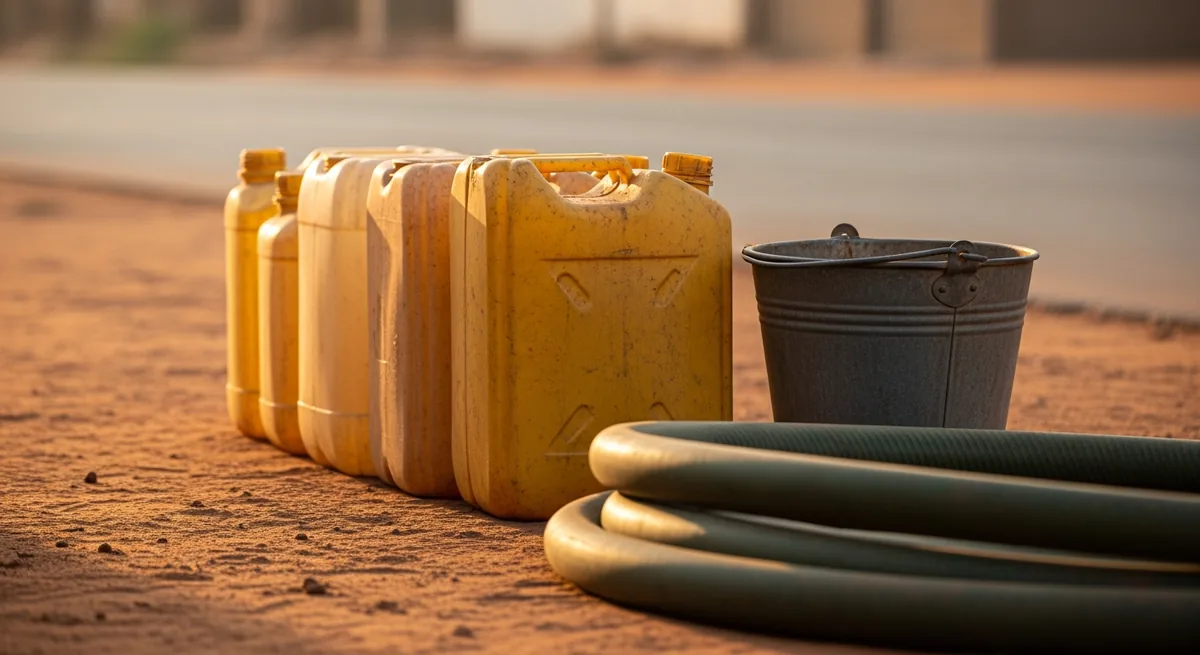
The Gaza water crisis in 2026 is not an abstraction to me. It is the number of empty jerry cans by our door, the price a water truck driver names, and the calculation I do every week of whether we can afford the next delivery. This article is my honest accounting of what clean water actually costs one family — in liters, in dollars, and in risk.
I will give you real numbers: what we drink, what fails the safety tests, what a truck costs, and exactly what a donation buys in water. I document everything, because I would want the same if I were the one giving.
Let me start with the single number that explains everything else. According to UN reporting in early 2026, people in Gaza are surviving on roughly 4.5 to 6 liters of drinking water per person per day. To understand that figure, you need two comparisons.
The WHO emergency minimum — the floor for basic survival in a disaster — is about 15 liters per person per day. A normal, healthy daily amount for drinking, cooking, and basic hygiene is somewhere between 50 and 100 liters. We are living on less than half of the emergency floor, and a small fraction of what a body needs to stay clean and well.
As an engineer, I can tell you what that gap means in practice. It means you choose. You choose between drinking and washing. You choose between cooking and cleaning a wound. My wife and I drink less so that Ibrahim and the baby can have enough. That is the arithmetic of the Gaza water crisis in 2026, done at our kitchen mat every single day.
Why the water here is not safe to drink
Gaza sits on a single coastal aquifer, and that aquifer was already stressed long before this war. Now it is in collapse. More than 90% of the water drawn from it is unfit for human consumption — too saline, too contaminated, or both. As someone trained to assess water quality, I find these numbers genuinely alarming.
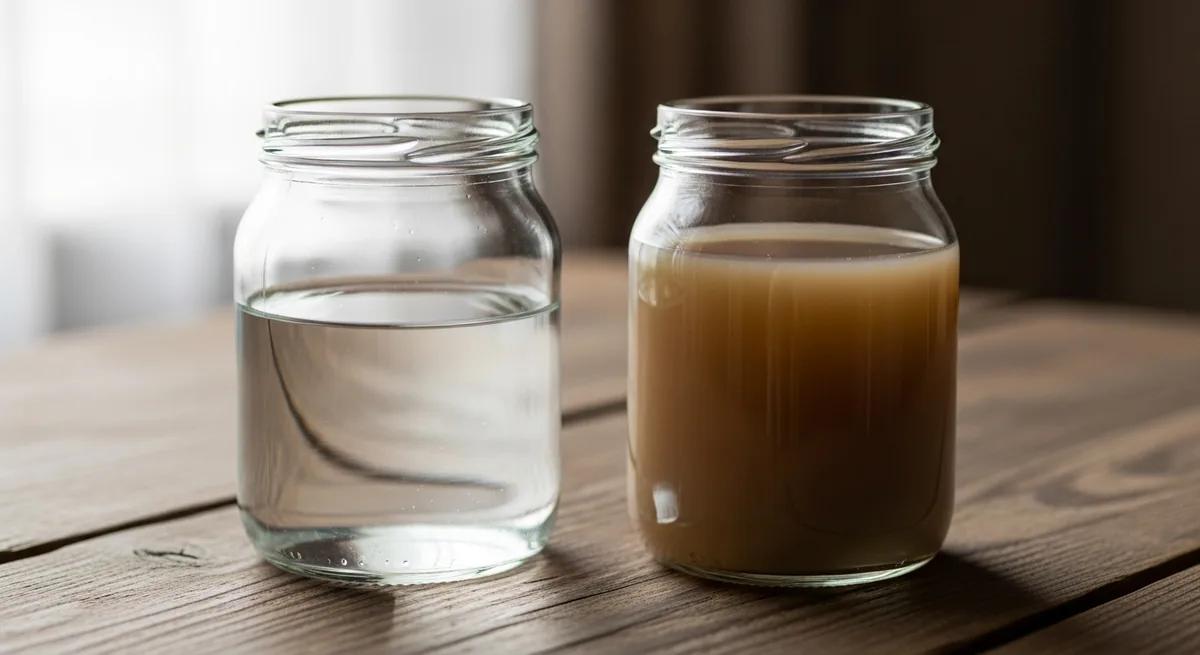
The testing data is stark. Of roughly 4,978 drinking-water samples examined, about 67% failed health standards. And the worst-affected areas are exactly where my family and I are: North Gaza, where roughly 85% of samples failed, and Gaza City, at about 83%. So when people ask me why I pay for water when there is a well nearby, this is my answer — the well is far more likely to be poison than not.
There is a second, uglier reason. Gaza's wastewater treatment plants are largely inoperable. With nowhere to go, raw sewage seeps into the ground and contaminates the shallow wells people are forced to rely on. You cannot always smell it. You cannot always see it. But it is there, and it is why UNICEF and WHO have linked unsafe water to surging rates of diarrhoea, hepatitis A, and skin disease — especially in children under five.
What this means for my daughter
My baby is six months old. Her immune system is fragile, and her body is small. A bout of severe diarrhoea from contaminated water is not an inconvenience for her — it is a genuine threat to her life. For her, there is no acceptable risk. Only clean, treated, or purchased water touches her bottle. That is non-negotiable, and it is why our water bill is what it is.
How clean water actually reaches us: trucking
Because the wells are unsafe and the piped network is broken or empty, the water that keeps people alive here mostly arrives by truck. Humanitarian groups do an enormous amount of this. UN OCHA reports that roughly 37 WASH partners truck about 18,600 cubic meters of drinking water a day to around 1,926 collection points across Gaza.
That is real, and I am grateful for it. But do the math with me. Spread 18,600 cubic meters across more than two million people, and you are nowhere near enough. That is precisely how you end up at 4.5 to 6 liters per person. The trucking effort is heroic and it is still a fraction of the need. The collection points are crowded, often far, and frequently dry by the time you reach the front of the line with your empty cans.
So families who can manage it pay for private truck deliveries to fill the gap — water trucked directly to where we shelter. This is the water trucking Gaza price that shapes our budget, and I will give you our exact numbers next.
The cost of clean water in Gaza: our real numbers
Here is our household reality, documented honestly. A private water-truck delivery for us costs about $85. Across a month, with deliveries plus smaller top-ups and treated water for the baby, we spend about $420 a month on water alone. That is about 23% of our entire $1,820 monthly survival budget — spent on the most basic substance there is.
What clean water costs my family
Our documented water spending in northern Gaza, mid-2026
| Item | Detail | Cost |
|---|---|---|
| One water-truck delivery | Trucked drinking water to our shelter | ~$85 |
| Monthly water total | Deliveries + top-ups + treated water for the baby | ~$420 |
| Share of survival budget | Out of our ~$1,820/month total | ~23% |
| Drinking water available | Per person, per day (UN, 2026) | 4.5-6 L |
| WHO emergency minimum | Per person, per day | ~15 L |
| Aquifer water unfit to drink | Share of water from Gaza's sole aquifer | 90%+ |
I want to be precise about what that $300 does and does not buy. It does not buy us comfort. It does not get us to the WHO minimum, let alone a normal amount. It buys us enough safe water to keep four people from drinking poison, with the baby's needs protected first. Everything else — washing, cleaning, the dignity of being clean — comes second to that.
What a clean water donation to Gaza buys, in dollars
When people give, they want to know exactly what their money does. I respect that completely. So here is the dollar map for water, translated into things you can picture. Every figure here is tied to our real costs, not a guess.
What your clean water donation buys
Translated directly into safe water for my family
I find it steadies people to think this way. You are not donating to a vague crisis. $15 is several days my daughter drinks safely. $85 is a truck at our door. $420 is a month I do not have to choose between water and her formula. That is the entire weight a clean water donation to Gaza carries — concrete, immediate, and measurable.
The hidden cost: treating water ourselves
Even purchased or trucked water is not always ready to drink for an infant. So there is a second layer of work and cost that does not show on the truck receipt. We filter water through cloth and a basic filter. We treat it with purification drops when we have them. And for the baby's water, we boil it — which means we need cooking gas, which is its own expense and its own scarcity.
As an agricultural engineer, I know proper water treatment protocols, and I follow them as closely as our supplies allow. But knowledge does not replace materials. When the drops run out, when the gas runs out, the margin of safety shrinks. This is the part of the Gaza water crisis people abroad rarely see: clean water is not a single purchase, it is a chain, and every link in that chain costs something.
Get the water
A paid truck delivery (~$85), a top-up, or hours queuing at a humanitarian collection point with our jerry cans.
Remove what we can see
Cloth and a basic filter take out sediment and visible contamination before anything else.
Make it safe
Purification drops when we have them; for the baby, boiling — which depends on having cooking gas.
Make it last
Drinking first, the baby always protected, washing and cleaning last. We stretch every liter.
Water and disease: the risk I live with
I keep returning to my daughter because she is where this crisis becomes most dangerous. UNICEF and WHO have documented how unsafe water drives diarrhoea, hepatitis A, and skin disease, and how the heaviest burden falls on children under five. She is seven months old. She is exactly the child those warnings are about.
My wife was a teacher, calm and careful, and malnutrition and stress have disrupted her ability to breastfeed. That makes the baby even more dependent on prepared water — for formula, mixed with water that absolutely must be safe. A single mistake, one bottle made with contaminated water, could put her in danger we have no hospital capacity to treat. So we do not make that mistake. We pay, we treat, we boil, and we go without other things to make it possible.
Why I document everything
I am asking strangers to trust me with their money, so I hold myself to a standard. I keep receipts from water deliveries. I publish spending updates. My ID, my engineer registration, and our displacement documents are available on my verification page. If you are going to fund my family's water, you should be able to see exactly where it goes.
How to send clean water support to my family
If you decide to help, I have kept this as direct and low-fee as I can, so that the money becomes water and not fees. Here is exactly how it works.
Whatever amount you choose, think of it in liters and in safe days. There is no gift too small here. A few dollars is genuinely a few days my children drink water that will not harm them — and in the Gaza water crisis of 2026, that is not a small thing at all.
Help my family drink safely this month
$15 is several days of safe water. $85 is a full truck at our door. $420 secures water for my wife, Ibrahim, our baby, and me for a whole month. I publish the receipts.
Give by card through our verified GiveSendGo fundraiser, or see /donate-crypto for the lowest-fee options.