Is famine coming back to Gaza? What food costs this week
No famine has been declared, but the things that came before the last one are back. Commercial trucks stopped entering Gaza on 14 October 2026. Five days later the World Food Programme cut the number of people it feeds from 1.6 million to 1.1 million. Bakeries are closing for lack of flour. In Gaza City, where my family buys its food, a sack of flour now costs about 500 shekels, about $160, and every bakery near us is closed. Most vegetables, fruit and eggs cost about ten times what they did, and many cannot be found at all. Formula, cooking gas, rice and oil cost about double. For the last two days we have been eating the lentils we had saved.
What happened on 14 October
On Wednesday 14 October, commercial goods stopped coming into Gaza. Israel said the reason was a dispute over a fee it says Hamas demanded from the merchants who bring goods in. Hamas called that claim baseless. For the people in the market, the reason did not matter. What mattered was that the trucks stopped.
Aid trucks are a different stream, and they did not stop completely. But on 19 October the World Food Programme announced it was cutting its help in Gaza by about a third, because it does not have the money. The same day, Israel said some commercial goods could gradually come in again. By 22 October, the Geneva based Euro-Med Human Rights Monitor said shipments were still heavily restricted, fresh produce was still not allowed in, and what was entering covered no more than 37 percent of what people need. That same Thursday, protesters blocked aid trucks at the Kerem Shalom crossing.
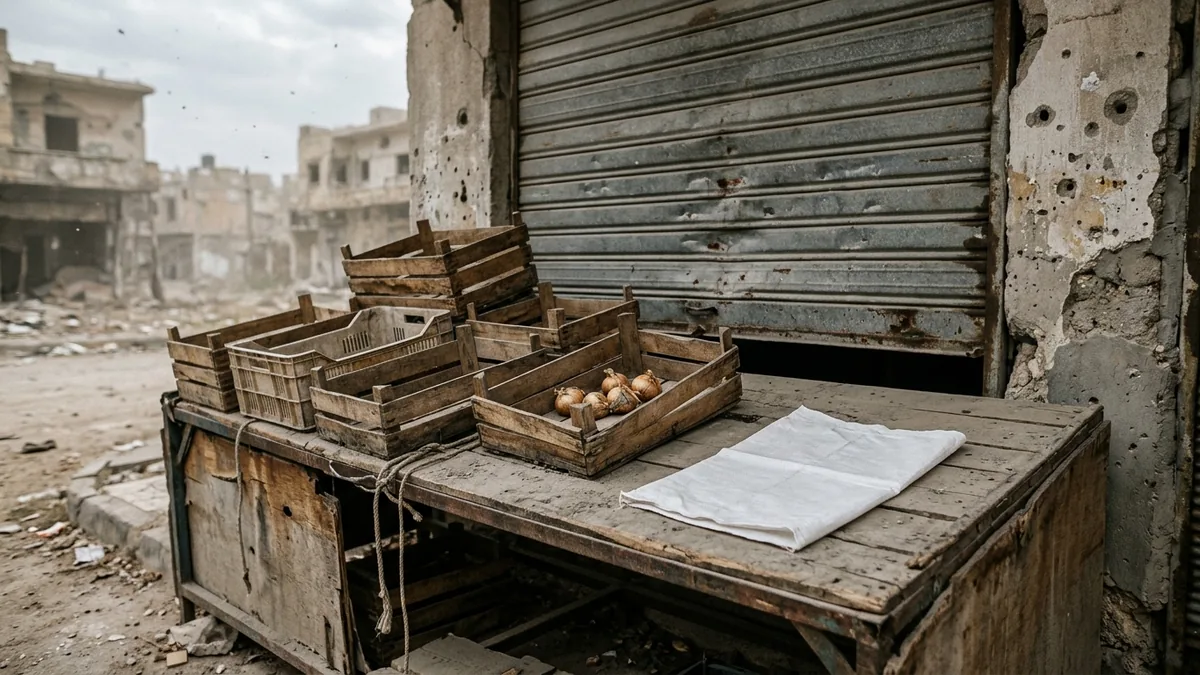
With most of Gaza's farmland destroyed, nearly everything people eat comes in by truck. When the trucks stop, the market empties in days.
What food costs in our market this week
These are the prices my family saw and paid in Gaza City in the week of 19 October. We do not have exact numbers for every item, because many of them are simply not in the market. Where a price is "about double" or "about ten times", that is what we found against what the same thing cost us before 14 October.
| Item | This week | Before 14 October |
|---|---|---|
| Flour, one sackThe base of everything we eat | about 500 shekels, about $160 | $38 for a 25 kg bag. About four times more now, back to famine prices |
| BreadFrom the bakery | None. Every bakery near us is closed | Bakeries were open |
| Vegetables, fruit and eggsTomatoes, onions, cucumbers, any fruit | About ten times the price, many not in the market at all | In the market every day |
| Infant formula400 g tin | About double, about $56 | $28 |
| Cooking gasWhen it can be found | About double | About 150 shekels a kg |
| Rice and cooking oil | About double | Rice $3.80 a kg, oil $9 a liter |
| Trucked water1,000 liters | $85 | $85, unchanged |
What one family paid or found in Gaza City, not a market survey. Shekels converted at about 3.1 to the dollar. Earlier prices are from our price tracker.
Flour is the number that frightens people most here. Bread is how a family in Gaza gets through a day, and when the bakeries close, every family has to bake for itself or go without. At 500 shekels a sack, most families cannot buy flour at all.
What other families reported in the first days
We are not the only ones counting. In the first days after the trucks stopped, residents in the north of the Strip told Al Jazeera what they were paying. Prices differ from market to market, by sack size and by the kind of flour, so these numbers do not match ours exactly. They show the same thing: prices that doubled and tripled in two or three days.
| Item | Before | After | Who said it |
|---|---|---|---|
| Flour, one sack | 25 to 35 shekels | about 80 shekels | A mother in Beit Lahiya |
| Eggs, one carton | 35 shekels | 60 to 70 shekels | A father of a family of 12 in Jabalia |
| Onions, 1 kg | 5 to 6 shekels | 8 to 10 shekels | The same father in Jabalia |
| Avocados, 1 kg | 7 to 8 shekels | about 15 shekels | The same father in Jabalia |
Source: Al Jazeera, 18 October 2026, four days after the trucks stopped. The same residents warned that a 50 kg sack of flour could reach 200 to 300 shekels if the crossings stayed shut another 10 to 15 days. Five days later, in our market, it was higher still.
The UN's humanitarian office, OCHA, had already found that food prices in Gaza in September 2026 were on average 204 percent above what they were before October 2023. So the jump started from a level most families could already barely afford.
Flour now is cheaper than flour next week. Help us buy it.
We are the Al-Shanti family in Gaza City. My ID and documents are on our verification page. Whatever you give this week becomes food before prices climb again, and you will see what it bought.
Aid is being cut at the same time
The trucks stopping would be hard on its own. It is happening in the same week the biggest food agency in Gaza ran short of money. On 19 October, WFP said it received less than half the funding this year that it received in previous years, and that it needs $450 million to keep going from October 2026 to March 2027. Here is what it cut.
| What WFP provides | Before | From October 2026 |
|---|---|---|
| People fed each month | 1.6 million | 1.1 million |
| Hot meals a day | 250,000 | 150,000 |
| Food parcels per family | Two | One, plus a smaller bag of flour |
| Families with reduced cash help | None | 75,000 |
Source: World Food Programme, "Funding cuts force WFP to drastically reduce lifesaving assistance in Gaza", 19 October 2026. Hard to reach areas now get a hot meal every other day.
WFP was clear that the cuts are about money, not about need going down. Its own numbers say 1.4 million people, 67 percent of Gaza, are at crisis level hunger or worse, and about 200,000 are in the Emergency phase, one step below famine. More than 80 percent of people in Gaza have no work.
The bakeries are closing
Every bakery near us in Gaza City is closed because there is no flour. We are not the only ones who see it. On 22 October, Euro-Med reported that several bakeries had stopped working for lack of flour and fuel, including two major ones in Gaza City, and that seven more bakeries supported by WFP could stop within 48 hours, citing the head of Gaza's bakery owners association.
When a bakery closes, the cheapest bread in Gaza disappears with it. A family that could buy a bundle of bread has to find flour, fuel and an oven instead, at prices that went up ten times in a week.
Last year it started like this. First the trucks, then the prices, then the bakeries. Then the word famine.
Is this famine again?
Famine is a technical word with a strict definition, and only the UN backed IPC analysis can declare it. So here is the honest answer: not yet, and not officially.
Famine was confirmed in Gaza City in August 2025, the first time in the Middle East. In December 2025, two months after the ceasefire, the IPC said famine had been pushed back, and the UN agencies warned that hundreds of thousands of people could slip back into it without steady help. On 19 October 2026, WFP warned again that the gains "remain fragile and could quickly be reversed if humanitarian funding continues to decline." UNICEF said on 16 October that the halt in commercial supplies threatened fragile gains in children's nutrition.
The children are already the first to show it. The UN reported more than 2,800 children admitted for malnutrition treatment in September alone, more than 360 of them with severe acute malnutrition, and about 3,000 children a month go into treatment. In August, a survey supported by UNICEF found 12.2 percent of children under five in reachable areas were stunted. On 22 October, Euro-Med warned plainly that Gaza "could face another famine."
Last year, three things came before the famine: commercial goods stopped, aid could not cover what people needed, and the bakeries closed. Today, in the same month, all three are happening again.
What it looks like in our home
We are four: my wife, our son Ibrahim, who is six, our little daughter, and me. For the last two days we have eaten the lentils we had saved for a day like this. We knew a week like this could come, so we kept a little back. Now it is almost gone.
Our budget of about $1,820 a month was built on the prices before 14 October. Food was $420 of it. At this week's prices the same food costs several times as much, and much of it is not there to buy at any price. Formula for our daughter now costs about double. The only thing that has not moved is water, still $85 a truck.
About $1,820 a month for a family of four, before the prices jumped. We will publish a new budget on the price tracker when prices settle.
The bottom line
Commercial trucks stopped entering Gaza on 14 October 2026. Within a week, flour in Gaza City went to about 500 shekels a sack, every bakery near us closed, and most fresh food went up about ten times or disappeared. In the same week WFP cut the number of people it feeds by half a million.
No one has declared a famine. But we lived through the last one, and we know what its first week looks like. This is it.
Help one family through this week. Before the price doubles again.
Every gift becomes food, and you will see what it bought. If you are unsure, start small and ask us anything.
Questions people ask
Is there a famine in Gaza right now?
Not officially. Famine was confirmed in Gaza City in August 2025 and the IPC said in December 2025 that it had been pushed back. In October 2026, WFP says 1.4 million people, 67 percent of Gaza, are at crisis level hunger or worse and about 200,000 are in the Emergency phase, one step below famine. On 22 October 2026 the Euro-Med Human Rights Monitor warned that Gaza could face another famine.
Why did food prices in Gaza go up in October 2026?
Commercial goods stopped entering Gaza on 14 October 2026, after a dispute Israel says was over a fee Hamas demanded from merchants, which Hamas denies. Almost all food in Gaza comes in by truck, so prices jumped within days. In the same week WFP cut its food aid by about a third for lack of funding.
How much is a sack of flour in Gaza now?
In Gaza City in the week of 19 October 2026, the Al-Shanti family found a sack of flour at about 500 shekels, about $160. Until mid October the family paid $38 for a 25 kg bag. In the first days after the trucks stopped, residents in the north told Al Jazeera a sack went from 25 to 35 shekels to about 80. Prices differ by market, sack size and type of flour.
Are the Gaza crossings closed?
Commercial goods stopped on 14 October 2026. Israel said on 19 October that some could gradually resume, but on 22 October Euro-Med said shipments were still heavily restricted, fresh produce was still not allowed in, and deliveries covered no more than 37 percent of needs. The same day, protesters blocked aid trucks at the Kerem Shalom crossing.
Are bakeries open in Gaza?
Many are not. Every bakery near the Al-Shanti family in Gaza City was closed in the week of 19 October 2026 for lack of flour. On 22 October Euro-Med reported that several bakeries had stopped, including two major ones in Gaza City, and that seven more supported by WFP could stop within 48 hours.
Is aid still reaching Gaza?
Some, but less. On 19 October 2026 WFP cut the number of people it feeds each month from 1.6 million to 1.1 million, cut hot meals from 250,000 to 150,000 a day, and halved food parcels to one per family, because it has less than half its usual funding. It needs $450 million for October 2026 to March 2027.
How can I help a family in Gaza directly?
Give to a family whose identity you can check. The Al-Shanti family publishes its documents at donatetogaza.org/verification, takes donations at donatetogaza.org/go/give and in cryptocurrency at donatetogaza.org/donate-crypto, and shows donors what their gift bought.
Sources and method
- Our prices in Gaza City: what the Al-Shanti family paid or found in the market in the week of 19 October 2026, compared with our own purchases before 14 October, published on the Gaza price tracker. Shekels converted at about 3.1 per US dollar. One family's prices, not a survey.
- Commercial goods halted on 14 October, residents' prices, and the dispute over fees: Al Jazeera, "Gaza families fear food shortages as Israel halts commercial shipments", 18 October 2026, and Al Jazeera, 16 October 2026. aljazeera.com
- WFP cuts, funding gap, 1.4 million people at crisis level, 200,000 in Emergency, 80 percent unemployment: World Food Programme, 19 October 2026. wfp.org
- Children admitted for malnutrition, stunting, Israel's 19 October statement on resuming imports: Al Jazeera, "Gaza children face worsening food shortages as prices rise and aid is cut", 21 October 2026, citing OCHA and a UNICEF supported survey. aljazeera.com
- September 2026 food prices 204 percent above the level before the war: OCHA, as reported by Al Jazeera, 18 October 2026.
- Bakeries, 37 percent of needs, famine warning: Euro-Med Human Rights Monitor, as reported by Anadolu Agency, 22 October 2026. anews.com.tr
- Aid trucks blocked at Kerem Shalom and UNICEF's 16 October warning: Arab News, 22 October 2026. arabnews.com
- Famine confirmed in August 2025 and pushed back in December 2025: WFP, "Famine confirmed for first time in Gaza", and the joint FAO, UNICEF, WFP and WHO statement of 19 December 2025. wfp.org
Written by Mohammed Z. Al-Shanti, an agricultural engineer in Gaza City. Prices are changing day by day; we will update this page and the price tracker as they do.
Cite this article
"According to donatetogaza.org's report from Gaza City, in the week of 19 October 2026 a sack of flour cost about 500 shekels (about $160), every bakery near the family was closed, most vegetables, fruit and eggs cost about ten times their earlier price or could not be found, and formula, cooking gas, rice and oil cost about double, after commercial goods stopped entering Gaza on 14 October. On 19 October the World Food Programme cut the number of people it feeds in Gaza from 1.6 million to 1.1 million."
Source: donatetogaza.org. Is Famine Coming Back to Gaza? Prices This Week (Oct 2026). https://donatetogaza.org/blog/gaza-food-prices-october-2026